There is nothing quite as heartbreaking as the moment you grab your keys and say "Wanna go for a ride?" to your senior dog, and instead of the excited tippy-taps and a sprint to the door, they look at you, look at the car, and walk away. We interpret this as a loss of interest, or maybe they are just "getting old" and don't like car rides anymore.
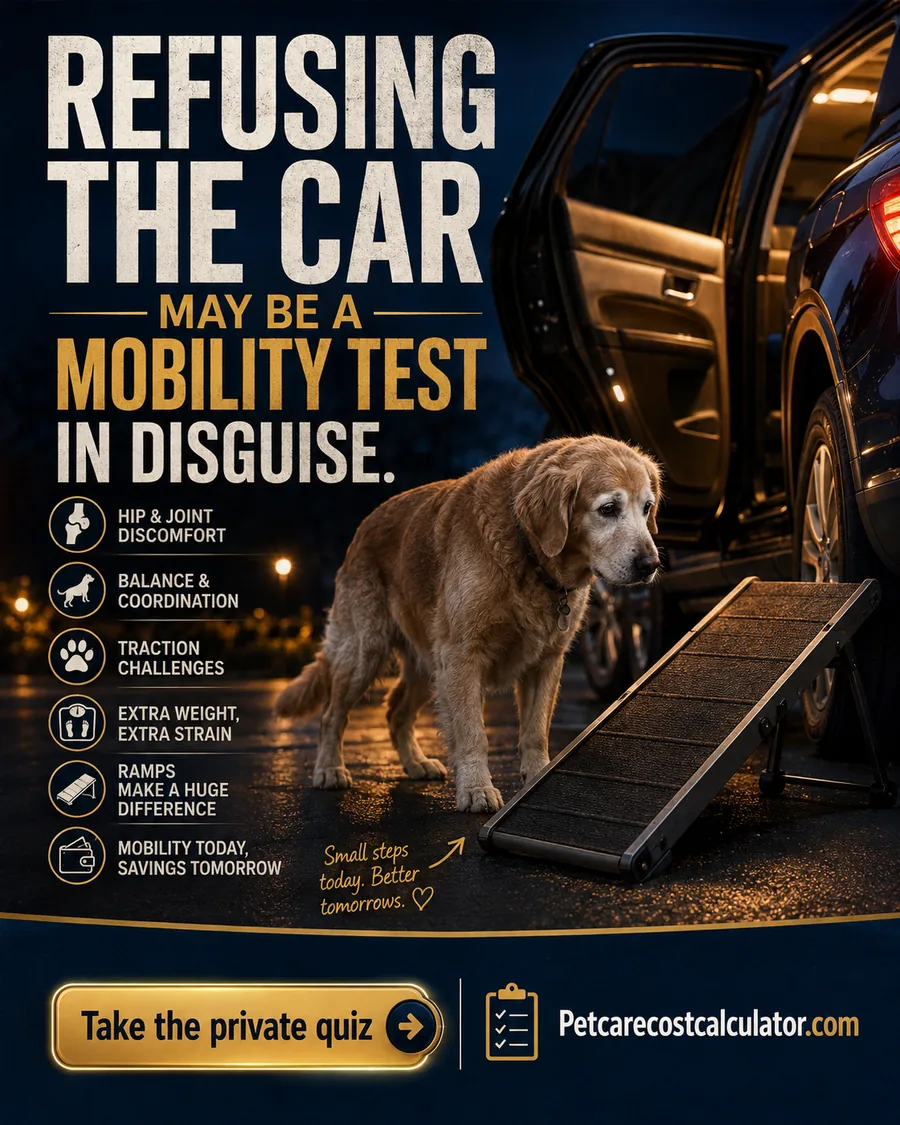
But the image glaring back at us reveals the true, painful mechanics behind this behavior: "Refusing the Car May Be a Mobility Test in Disguise."
We think they are refusing the car. But they are actually refusing the pain required to get into the car. Look at the list of issues associated with this behavior: "Hip & Joint Discomfort," "Balance & Coordination," "Traction Challenges," "Extra Weight, Extra Strain," and "Ramps Make a Huge Difference."
The Physical Struggle: For a dog with arthritis or hip dysplasia, simply lifting a leg to step onto the floorboard of an SUV is an agonizing task. Their hip joints are bone-on-bone. Their knees are swollen. The lack of traction on the leather or carpet seats makes it impossible for their paws to gain a foothold, causing them to slide backward. They are terrified of falling. They are terrified of the pain they know is coming when they jump.
The Cognitive and Muscular Decline: As they age, they lose muscle mass (sarcopenia). A younger dog can use their core to hoist themselves up. A senior dog has weakened core muscles, and their balance is off. They look at the car, they calculate the jump, and they realize they physically do not have the strength to make it.
The "Ramp" Solution: The image suggests that "Ramps Make a Huge Difference." This is a physical workaround. It is an external tool to help them get into the car. But here is the critical question: Are ramps helping them, or are we just adapting to their decline?
A ramp physically moves the dog from point A to point B without the pain of the jump. But the reason they need the ramp—the joint pain, the muscle loss, the balance issues—is still there.
When a dog refuses to get in the car, it is a massive warning shot. It means their mobility is severely compromised. It means that everyday tasks—walking up stairs, getting on the couch, walking to the end of the driveway—are all requiring massive amounts of effort.
We have to ask ourselves: Are we setting up our pets for a life of immobility? Are we waiting until the joints are so broken that they need a physical ramp to live their lives?
The answer is that we need to install a "biological ramp" inside their bodies long before they need an external one. The key to maintaining mobility is protecting the synovial fluid in the joints, rebuilding cartilage, and most importantly, fighting the systemic inflammation that destroys the joints.
If you maintain their joint flexibility and strength while they are still young and middle-aged, you won't need a physical ramp in their senior years. They will still jump into the car with the same eagerness they had as puppies.
Don't let the "Refusal to get in the car" be your wake-up call to a lifetime of limited mobility and expensive orthopedic surgeries. Understand that their hesitation is a test of their biological structure. Give them the internal tools to pass the test every single time. Protect their hips, support their ligaments, and watch them run to the car door again.
Not sure what pet care may cost?
Use the free private assessment to organize likely treatment and cost questions before you speak with a veterinary provider.
Take the Private QuizRelated Idaho pet-care cost guides
Dog ACL / TPLO Surgery Cost in Idaho · Vet X-Ray Cost in Idaho