You look over at your senior dog or cat. Their bowl is empty. But instead of feeling satisfied that they ate their breakfast, you feel a knot in your stomach. You know they only ate half of what they used to. They used to gobble food down, but now they take their time. They walk up to the bowl, sniff it, pick at it, and walk away. We often assume that a pet who stops eating is just being "picky" or getting "finicky" with age.
But that empty bowl is hiding a painful secret. It is hiding a difficult meal.
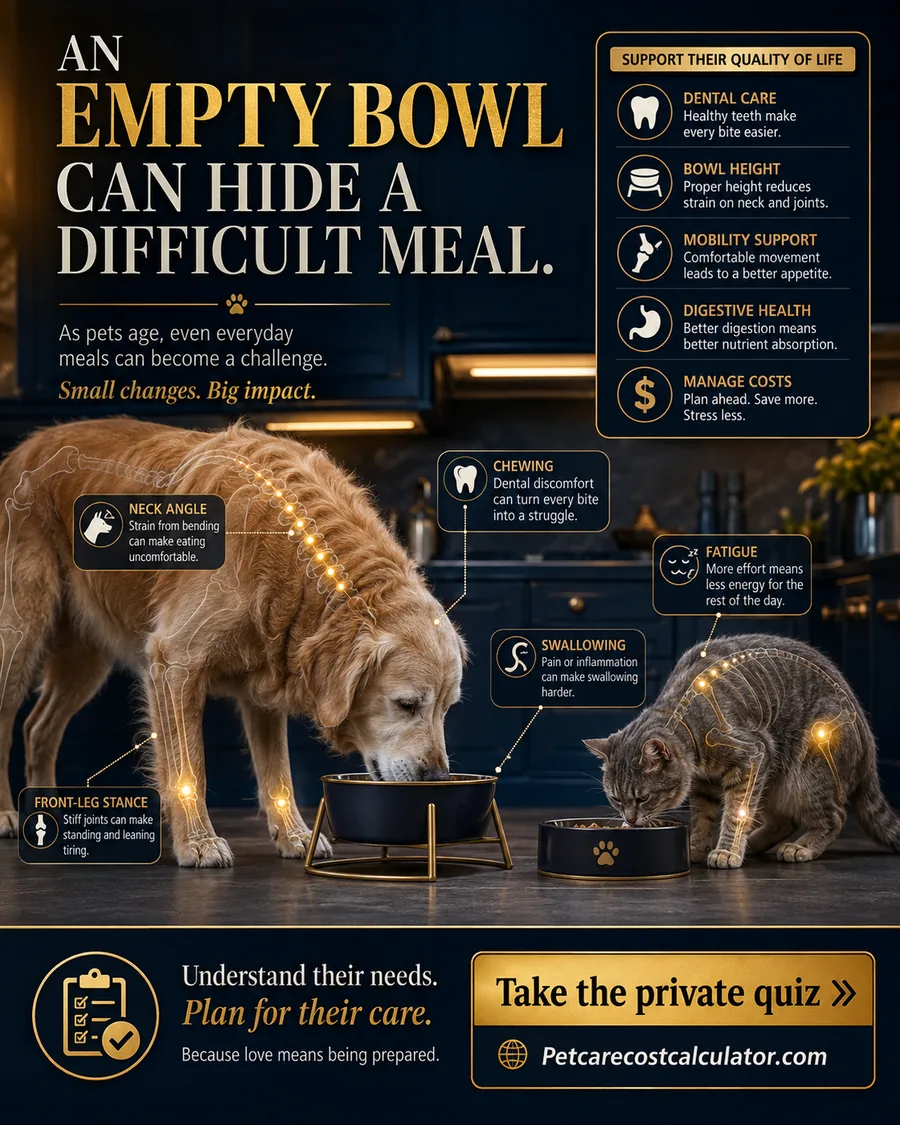
This image brilliantly dissects the biology behind a refusal to eat. It shows us that eating is not just about hunger; it is a complex mechanical process that relies on the health of their entire body.
First, think about the physical mechanics. An aging dog has stiff joints. The image shows a diagram of a dog leaning over a bowl, with highlighted areas in their neck and front legs. If their neck is stiff, leaning down to eat causes them pain. If their front leg stance is compromised due to arthritis in their shoulders or elbows, standing in that position becomes a tiring chore. Every meal becomes a form of physical exertion. They don't have the energy to eat because their joints are screaming at them to lay down.
Now, look at their teeth. The image highlights "Chewing" and "Dental discomfort." As pets age, their teeth decay. Gingivitis turns into periodontitis. The gums recede, exposing the sensitive nerves of the teeth. Their teeth ache. When they bite down on hard kibble, it hurts. So, they chew slower, or they try to swallow food whole, which leads to choking. They avoid the hard pieces, they drop food out of their mouth, and eventually, they just walk away. The pain of eating outweighs the pleasure of being full.
And beneath that mechanical struggle lies the invisible world of "Swallowing" and "Digestive Health." As they age, their digestive systems slow down. They produce fewer enzymes. Their gut microbiome shifts, leading to inflammation. The process of digestion becomes uncomfortable. They eat less because their digestive tract is inflamed and struggling to process the nutrients.
This brings us to a terrifying conclusion: We have animals dying of starvation while sitting next to a full bowl of food. They are starving because their bodies cannot physically handle the mechanics of eating, and their gut cannot absorb the nutrients.
We often try to fix this problem by buying "senior" food, or wet food, or softer kibble. But we are treating the symptom, not the cause. We are changing the texture, but we aren't fixing the underlying joint pain, the severe dental inflammation, or the systemic inflammation that is wrecking their gut.
The secret to supporting an aging pet is reducing the burden on their body from the inside out. We need to address that "Neck Angle" by ensuring their joints are lubricated and free of pain. We need to address the "Chewing" by ensuring their gums are healthy and their oral microbiome is balanced. But most importantly, we need to address the "Digestive Health."
If we reduce the chronic inflammation in their body, we reduce the pain. If we reduce the pain, eating becomes easier. If we support their digestive tract with anti-inflammatory compounds and probiotics, their gut can heal, and they can actually absorb the life-sustaining nutrients from their food.
The empty bowl is a cry for help. It is not a sign of a picky eater; it is a sign of a body that is fighting an uphill battle just to survive. Your pet wants to eat. They are starving. But their aging biology is making it impossible.
You have to step in and be their advocate. Don't just buy different food. Change the biology. Address the inflammation, protect the joints, and heal the gut. Let your best friend enjoy their meals again. Give them the energy to run to the bowl, not just walk away from it.
Not sure what pet care may cost?
Use the free private assessment to organize likely treatment and cost questions before you speak with a veterinary provider.
Take the Private QuizRelated Idaho pet-care cost guides
Cat Dental Extraction Cost in Idaho · Dog Dental Extraction Cost in Idaho