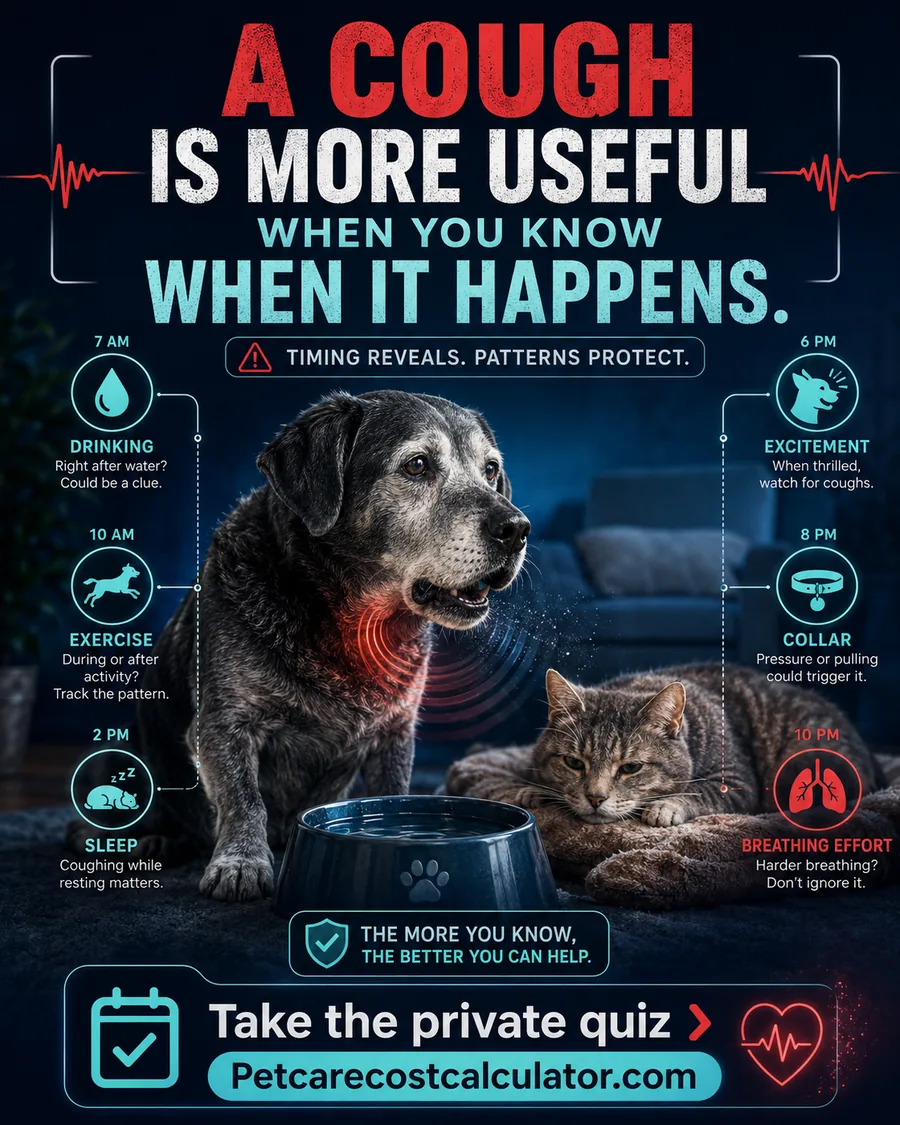

There is a small, nagging sound that often goes ignored in our homes. The cough. When we hear our dog or cat cough, we usually take a quick glance, see that they are okay, and move on with our day. We chalk it up to them having a dry throat, or "swallowing wrong." But the image before us presents a brilliant, life-saving framework: "A cough is more useful when you know when it happens. Timing reveals. Patterns protect."
We are missing vital data by ignoring the context of the cough. By simply documenting when the cough occurs, we can unlock the secrets to their internal health.
The 7 AM Cough: Drinking. If your pet coughs right after drinking water, or immediately after eating, it could be a sign of laryngeal paralysis, a condition common in older large breed dogs (like Labs and Goldens). It indicates that the nerves controlling the larynx are degrading, allowing water and food to enter the airway. It could also signify megaesophagus, where the esophagus is enlarged and lacks motility.
The 10 AM Cough: Exercise. If they cough during or immediately after physical activity, this is a massive red flag for cardiovascular disease or a collapsing trachea. The heart cannot pump enough blood to support the sudden oxygen demand, causing fluid to back up into the lungs (congestive heart failure), or the rings of the trachea are weak and collapse when they inhale rapidly. This is a progressive, deadly disease.
The 2 PM Cough: Sleep. Does the cough get worse when they are lying down? This often indicates fluid accumulation in the lungs or a collapsing trachea that worsens when the neck is stretched out. It is a sign that their lungs are already compromised.
The 6 PM Cough: Excitement. If the cough is triggered by barking, jumping, or anticipating a treat, it is almost certainly a collapsing trachea or bronchitis. The high-pressure air pushing through irritated airways triggers the cough reflex.
The 8 PM Cough: Collar Pressure. Does the cough happen when they pull on their leash? Is their collar pressing against their throat? It is a direct sign of tracheal sensitivity and damage.
The 10 PM Cough: Breathing Effort. If they are coughing at night, or if they are showing labored breathing, panting, or blue-tinged gums after coughing, this is an absolute emergency. They are fighting for every breath.
The diagnostic power of tracking these patterns is incredible. When you go to the vet and say, "He has a cough," they have to run a million tests. But when you say, "He only coughs at 10 AM on our walk, and it sounds like a honking goose," the vet can narrow it down to a likely tracheal collapse and save you thousands in unnecessary diagnostics.
But here is the deeper insight. Why are these structures breaking down? Why are the laryngeal nerves degenerating? Why are the heart valves degrading? Why are the muscles of the esophagus weakening? It is the relentless march of cellular aging and systemic inflammation.
The tissues are losing their elasticity, their strength, and their ability to repair themselves. By tracking the patterns, you get a clear timeline of their internal degeneration. And by intervening early—supporting their cardiovascular system, reducing inflammation in their airways, and protecting their neurological health—you can slow this degeneration down.
Don't ignore the cough. Write it down. Watch the clock. Your pet is trying to tell you exactly what is wrong with them. Track the patterns. Protect their future. The more you know, the better you can help them breathe easy for years to come.
Not sure what pet care may cost?
Use the free private assessment to organize likely treatment and cost questions before you speak with a veterinary provider.
Take the Private Quiz