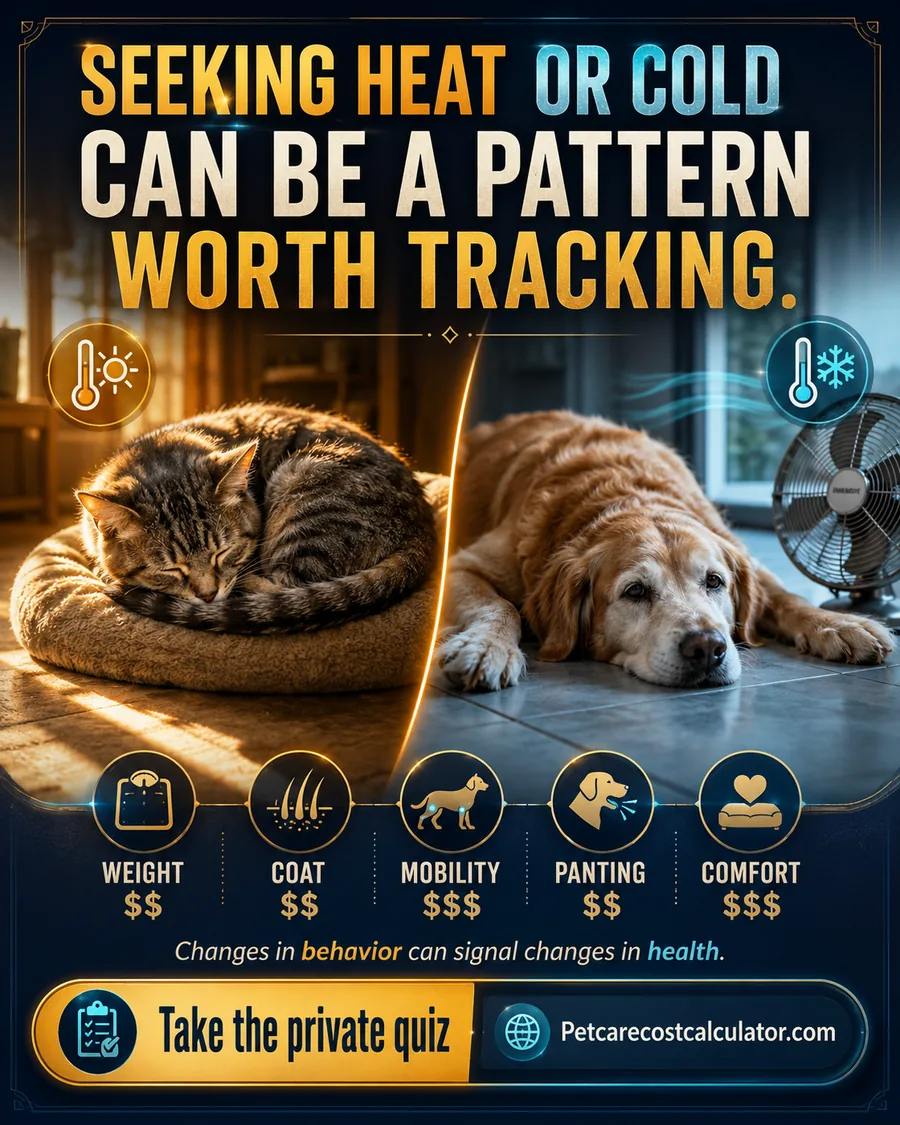

Have you ever noticed that your cat has started sleeping exclusively in front of the heater? Or maybe your older dog, who used to love cozying up on the couch, is now spending hours lying on the cold, hard tile floor in the kitchen? We often think it's just a cute quirk. We smile and say, "Oh, she loves the warmth," or "He's just trying to cool off."
But the truth is much more clinical. "Seeking Heat or Cold" is a pattern worth tracking, and it is one of the most ignored health clues our pets give us.
Look at the diagram in the image. It highlights the hidden costs associated with these thermal behaviors: Weight, Coat, Mobility, Panting, and Comfort.
When a pet is constantly seeking heat, it is often a sign of decreased circulation and poor metabolic function. Older animals have a slower heart rate and stiffer blood vessels. Their body simply cannot generate enough internal heat to keep them warm, which causes them to actively seek out external heat sources. It is a clear signal that their cardiovascular system is aging. Additionally, muscle loss (sarcopenia) reduces the body's ability to generate heat, leaving them cold.
On the flip side, constantly seeking cold air—panting, laying on tile, avoiding blankets—is a massive red flag for systemic inflammation. When the immune system is chronically activated, the body produces extreme internal heat. The heavy panting is not just them being tired; it is their body trying to cool down a raging, low-grade fever caused by internal inflammation. This inflammation is often hiding in the joints, in the gut, or in the organs. They are actively trying to fight off the internal heat of cellular decay.
Furthermore, tracking mobility alongside this tells you more. A dog that is overweight but seeking cold air is struggling to move because the fat layers are trapping heat and stressing their inflamed joints. A dog that is underweight and seeking heat is fading away due to a lack of cellular energy.
We look at these behaviors as "Comfort" issues. We buy them heated beds or cooling pads. But we are treating the symptom, not the disease. We are letting our pets suffer in silence because we think their desire for heat or cold is just a personality trait.
But it is a pattern. It is a pattern of cellular fatigue, vascular decline, and inflammatory stress. If you track these patterns, you can intervene before they turn into a critical illness.
Instead of just buying a cooling pad for the dog panting on the tile, what if you addressed the systemic inflammation that is causing his internal heat to spike? Instead of buying an electric blanket for the cat that hides under the covers, what if you supported their blood flow and circulation, giving them the energy to maintain their own body temperature?
Our pets cannot tell us when they feel cold, or when they are experiencing pain. They rely on us to interpret their instincts. If they are seeking heat, they are starving for energy. If they are seeking cold, they are drowning in inflammation.
The next time you see your dog stretched out on the hard floor, or your cat buried deep in the blankets, don't just assume it's a cozy habit. Look at their weight, check their coat, watch their mobility. See it as a clue. See it as a pattern. And understand that the cost of comfort is rising because the underlying biology is failing.
It is time to support their body's natural thermal regulation. Give them the cellular tools to live comfortably, without having to seek out external crutches.
Not sure what pet care may cost?
Use the free private assessment to organize likely treatment and cost questions before you speak with a veterinary provider.
Take the Private Quiz